
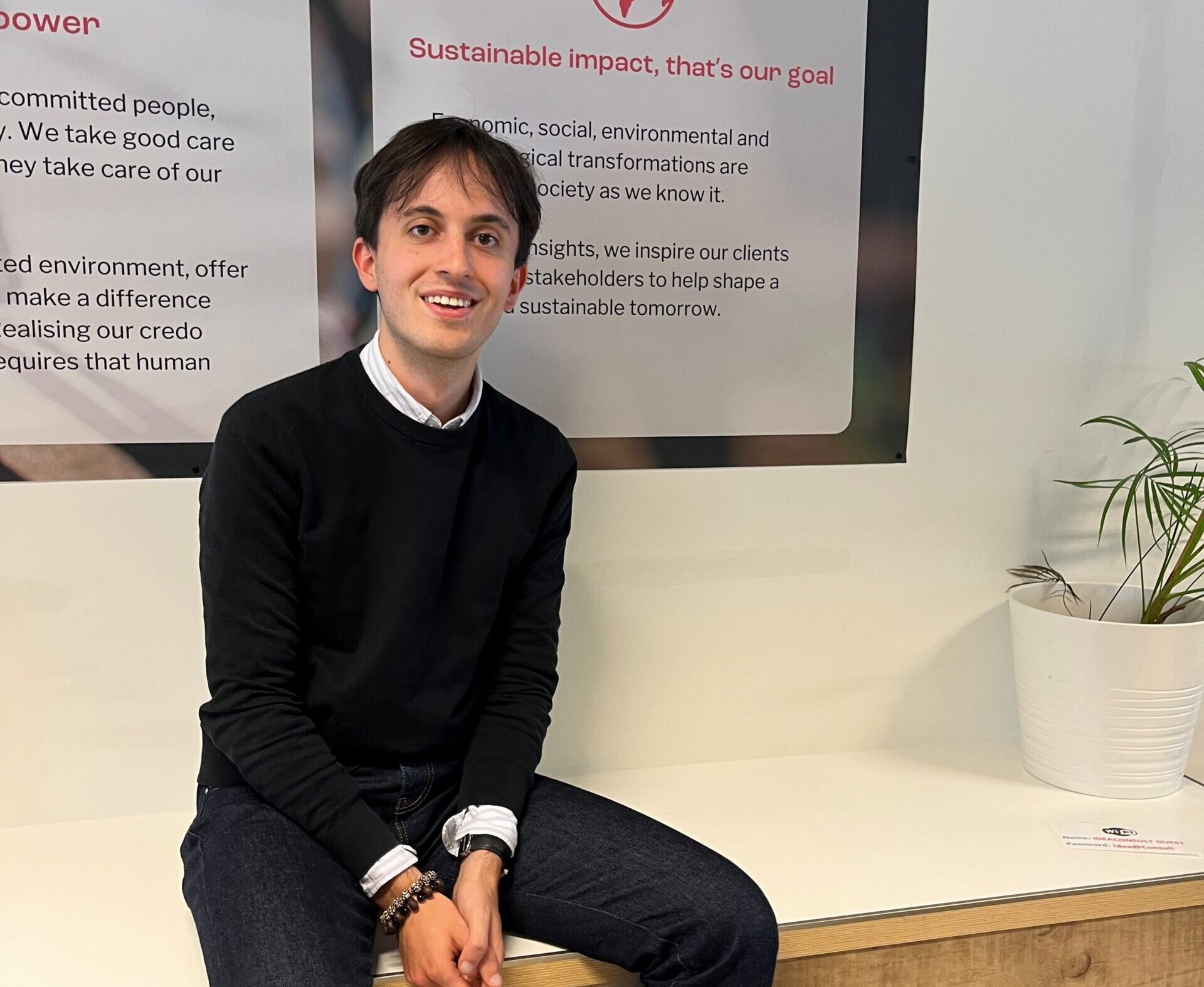
Gilles Cremers (20) is studying Public Administration at Ghent University. As a third-year undergraduate, he undertook a three-month placement at IDEA Consult. He investigated the extent to which local authorities were required to make savings when drawing up the 2026–2031 multi-year plan, and how they went about tackling this challenge. We spoke to Gilles about his first steps in research and consultancy.
Hello Gilles, could you briefly introduce yourself and tell us how you came to do your placement at IDEA?
When choosing an internship placement, I was immediately drawn to the fascinating intersection at which IDEA operates: translating recent research insights into concrete and practical advice for organisations. IDEA also has an excellent reputation at Ghent University as an internship supervisor – something I can certainly confirm at the end of my placement. My internship supervisors, Bart Van Herck and Jolijn De Roover, kept me on the right track, challenged me and offered constructive criticism.
What did your internship involve in practical terms?
I conducted research into cost-saving measures within local authorities in response to the 2026–2031 multi-year plan. We started by conducting a survey of all finance directors (FDs). 104 of them responded, and I was then able to hold in-depth discussions with 23 FDs about why they needed to make savings, how they arrived at their decisions and how they are building support for these measures. I was able to test my findings in a feedback session with members of VVSG, ABB, VloFin and a number of FDs from local authorities.
You investigated cost-cutting measures in Flemish cities and municipalities. Are many local authorities facing this issue?
Very many. The survey revealed that around 4 in 5 local authorities found drawing up their multi-year plans a more challenging exercise than in previous legislative periods.
What were the key findings and insights from your research?
Planning at local level is no easy task, given so many uncertainties. Inflation, fluctuating grants, rising staff costs and new regulations make financial planning more complex than ever. This forces local authorities to work with scenarios and buffers. Local authorities face so many challenges that making savings has become a structural task that will recur in every legislative term.
But the financial pressure also has a positive side. It forces local authorities to take a critical look at their own operations: which services are essential, and which are less of a priority? And perhaps that is precisely the most important benefit: local authorities are becoming more mindful of how they use public funds.
How can local authorities benefit from your work?
Local authorities can learn from my interviews which approaches worked, what challenges fellow authorities faced, and what should be handled differently in future. The report concludes with a series of practical recommendations. I’d like to share one in particular: ensure that consultation is more than just a formality – engage in a well-conducted dialogue with internal and external stakeholders before, during and after decisions are made.
What will you remember most from your placement?
Academically speaking, undoubtedly the art of conveying a message clearly and concisely.
I have a nice anecdote about this from the start of my placement. When I was drafting a LinkedIn post to reach out to respondents for the research, I remember that Bart and Jolijn were able to reduce my text to a third of its length whilst retaining the same core message. That set the tone straight away.
On a personal level, what will stay with me is the rapport with my colleagues. The lovely chats in the park, by the coffee machine or at the dining table. So, it was not only an educational but also an enjoyable placement.